Here's a call that comes in often: "We had the septic pumped last month, and the tub is backing up again." Pumping empties the tank. It doesn't do a thing for the pipe leading to it. When a backup survives a pumping, the sewer line is usually where the answer is.
The pipe nobody thinks about
Between your house and your septic tank is a run of buried pipe. Every drop of water and waste in the house travels through it. Past the tank, another line carries the liquid out to the leach field.
These pipes have no moving parts and don't need routine service, so they get forgotten. On a well-built line, that's fine for decades. On an older one, the clock is running.
Older lines in older yards
A lot of homes around Salisbury and out in the county went up long before PVC became the standard. Depending on the age of the house and whether the line was ever replaced, you might have:
- Clay tile pipe. Short sections joined end to end. Strong in the middle, weak at every joint, and roots love those joints.
- Orangeburg pipe. A black fiber and tar pipe used for a few decades in the middle of the last century. It tends to deform and flatten with age, and it can collapse.
- Cast iron. Usually right at the foundation. It rusts from the inside and can scale up until the opening narrows.
- PVC. The modern standard. It holds up well, though joints can still separate and pipe can crack under weight.
If you're not sure what you have, that's normal. A camera answers it in a few minutes.
Clay that won't sit still
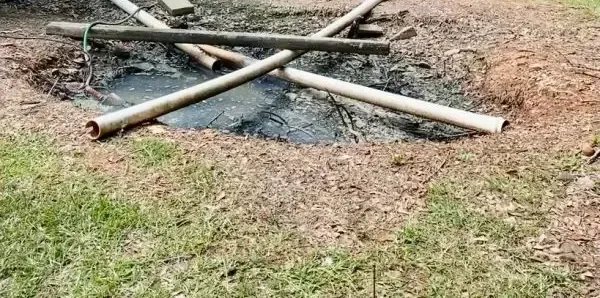
Rowan County's red clay swells when it's wet and shrinks when it's dry. A line laid in that clay moves a little every season. Over the years, the movement can pull a joint apart, crack a section, or let part of the pipe sag. A sag, often called a belly, holds standing water and solids. Flow slows, paper catches, and the line starts clogging in the same place over and over.
Signs it's the line
- Backups that return soon after pumping or snaking
- The lowest drain in the house acts up first
- A toilet gurgles when the washer drains
- A soft, sunken strip in the yard between the house and the tank
- Sewage odor near the cleanout or along that strip
- The tank level is low when it's opened, even though the house is backing up
That last one is a strong clue. If the tank isn't full and water still isn't getting there, the blockage is somewhere in between.
Finding the problem without digging up the yard
Straight talk: nobody should dig up your yard to find a pipe problem. The tools to find it from above have been around a long time.
- Camera inspection. A waterproof camera is pushed through the line from a cleanout or the tank. The technician watches for roots, cracks, sags, offset joints and crushed spots.
- Locating. A transmitter in the camera head lets the crew mark the exact spot and depth on the ground.
- Deciding the fix. With the footage in hand, the contractor can tell you whether you're looking at one bad joint or a line that's done.
Ask to see the video. A good contractor is glad to show you.
Patch, section or new line
Patch a joint. If one joint has separated or let roots in and the rest of the pipe is sound, the contractor digs at that one spot and replaces the joint with new pipe and couplings.
Replace a section. A belly or a stretch of cracked pipe gets cut out and replaced, and the trench is bedded properly so it doesn't sag again.
Replace the run. With clay tile or Orangeburg from end to end, patching tends to chase problems down the line. Replacing the whole run with PVC is often the cheaper choice over time.
Clearing roots with a snake or a jetter can get water moving today. It isn't a repair. Roots come back through the same opening.
The line past the tank
Sometimes the trouble is on the far side of the tank. A crushed or root-filled line between the tank and the distribution box can starve the field and flood the ground near the tank. That can look like a failed leach field when the field itself is fine. Before anyone quotes field work, make sure that line has been checked. If a cracked outlet baffle or tank connection is part of it, that falls under septic tank repair.
Selling or buying?
A home sale inspection looks at the tank and field. If the house has a history of backups, ask about running a camera through the sewer line too. A line problem is far easier to settle before closing than after.
What sets the price
The length and depth of the bad section, the pipe material, what's on top (lawn, driveway, landscaping), how many problem spots the camera finds and how much yard has to be restored. Our septic cost page explains how septic jobs are priced. Homes in Salisbury, Spencer, Granite Quarry and Faith can get a free visit and a written quote. Call (980) 944-4517.
Questions people ask
Can roots in my sewer line be fixed for good?
Clearing them is temporary. The lasting fix is replacing the joint or section the roots came through with solid pipe and tight joints. If a tree sits right on top of the line, rerouting the pipe sometimes makes more sense.
How do I know if I have Orangeburg pipe?
You usually can't tell from the surface. A camera inspection shows it clearly, since Orangeburg looks different from clay or PVC and often shows flattening or blistering. Homes built in the middle of the last century are the most likely candidates.
Should I have my line checked before a big family gathering?
If you've had slow drains or a backup in the last year, it's a smart move. Holidays push a lot of water through a line at once, and a weak spot tends to show up right then.
Does sewer line repair need a permit?
It depends on the scope of the job. The contractor should tell you before work starts whether yours needs one, and pull it through Rowan County Environmental Health if it does.